We finally did our performance at the Hospice on 10th July 2015 and overall it went really well.
The day began with us all arriving 2 hours before the performance time which allowed us to do an extensive vocal and physical warm up as well as a full run through and polishing of certain items. It really helped to get us settled and focused on the task in hand.
We then did the performance which ran smoothly, with everyone playing their individual parts. Prior to beginning the project I anticipated I would enjoy the performance the most out of anything else we had done but actually, I found that I enjoyed the process more. I enjoyed doing the performance but it was very much signalling the end of our time at St Christopher's, and I found that the process was the most important part for me. I thought the performance being public was very beneficial because it provided the patients with the service of being able to watch a performance, as many of them will not be able to go to a theatre any more. The audience reaction was very positive, with many of the patients getting emotional, which we were concerned about, but after speaking to them they told us that they were elated by the performance.
Something interesting to note at the end of the project was everyone's roles and responsibilities within the community theatre organisation;
Anna and Rachel - They took the role of the directors of the project and prepared us for our time at the hospice, week by week. They were successful at creating a piece of work that was well-structured and a process which was stimulating and achieved its purpose. They had a clear aim throughout the project that they were working towards and were vital to the whole proceedings.
Marion - She is the Arts Facilitator at St Christopher's and arranged the time slots when we could go and visit. She set up the project and was a key part of it; doing her best to ensure we had as many patients as possible and regularly checking on us to make sure we were okay.
The patients - They were, in my opinion, the main components of the whole project - their role was to provide us with the stimulus for our show and to talk to us about whatever they wanted.
The performers - We had the responsibility of being on time to rehearsals, which I think we mostly did, being attentive and responsive to whatever was placed in our way. We also had the responsibilities of attending every week and being truthful to one another. We had the role of performing at the end of the project and doing our best to make the performance as satisfying and as truthful to the patients as possible.
I learnt that there were many roles and responsibilities within a community project organisation, and that all rely on each other to create a fully functioning project and end result; the performance. Prior to the project I didn't realise that there were so many roles that people need to take, and it was much more difficult than I anticipated.
If I were to do the project again from the beginning I think I would be less nervous about meeting the patients - they were very down to earth and 'normal' people, I don't know why I built up apprehension prior to meeting them. I think I would also be more proactive in the rehearsals and volunteer to lead more, as I now have the skills and am less self-conscious of working with new people.
I have valued many things throughout this project such as meeting the patients and providing them with the service of listening. The most important thing for me was retelling the stories that people told us about themselves and finding the element of truth and honesty in the visual art form that we practice as performers.
Sunday, 12 July 2015

Thursday, 9 July 2015
Lesson 6 - 7/7/15
This week was very tight in terms of time, as we had lots of material and items for a show but nothing that linked them altogether and no running order. Therefore pace moved quickly and we all had to concentrate in order to make them most of the short time we had.
Throughout the morning we worked steadily through the running order that had been created. It was led by Anna and Rachel and I think we worked well as a company because everyone was focused solidly on the task. We were stitching the piece together and making alterations to items all morning. Personally I would have liked the whole piece to be complete so we could just run it this week, but it all came together in the end and we had a finished piece by the end of the morning.
Fortunately in the afternoon we were given the opportunity to perform for an audience made up of other students in our year. It was great to be under pressure to perform to the best of our abilities and to see how the piece works altogether. The performance went well other than a few technical glitches and we definitely needed the audience's presence to get a feel for how the piece may run on Friday. We also asked the audience to give us feedback, and the main comment was to 'give more' and 'commit more' which we can easily change and which will probably happen naturally in the real performance. It was a shame to learn that not everyone was giving 100% and I think it is everyone's role and responsibility within the group to ensure they know exactly what they are doing so they can fully commit to the performance.
 Between now and Friday I need to learn my lines for Jasmine's poem - the picture on the right. It is abut Bob so I need to make sure I know it off by heart and can deliver it well, putting the emphasis in the right place which is so important in poetry.
I also need to recap the movement for the fight scene and the rock 'n' roll dance to make sure that I know exactly what I'm doing because we devised them quite long ago.
Throughout the morning we worked steadily through the running order that had been created. It was led by Anna and Rachel and I think we worked well as a company because everyone was focused solidly on the task. We were stitching the piece together and making alterations to items all morning. Personally I would have liked the whole piece to be complete so we could just run it this week, but it all came together in the end and we had a finished piece by the end of the morning.
Fortunately in the afternoon we were given the opportunity to perform for an audience made up of other students in our year. It was great to be under pressure to perform to the best of our abilities and to see how the piece works altogether. The performance went well other than a few technical glitches and we definitely needed the audience's presence to get a feel for how the piece may run on Friday. We also asked the audience to give us feedback, and the main comment was to 'give more' and 'commit more' which we can easily change and which will probably happen naturally in the real performance. It was a shame to learn that not everyone was giving 100% and I think it is everyone's role and responsibility within the group to ensure they know exactly what they are doing so they can fully commit to the performance.

I also need to recap the movement for the fight scene and the rock 'n' roll dance to make sure that I know exactly what I'm doing because we devised them quite long ago.
Monday, 6 July 2015
Notes from conversations
Below are the notes that I took from the conversations that I have had with people over the weeks; snippets of their lives, special moments and things that are important to them. In my opinion it is very important to do this project and to express topics which are often quite difficult through the medium of art. The final performance should be beneficial and interesting for the people who can relive moments of their lives that they have told us about; us as performers to undergo the process of getting material and rehearsing a final production; and for any other spectator who watches the piece, as it should be an engaging and fulfilling piece of art.
Bob (2)
-Very shy, doesn't normally like speaking to new people, took a lot of courage for him to walk into the room.-Lives with his elderly mother and a few of his brothers and sisters, but they all work and he can't anymore so he stays at home a lot of the time.-He takes each day as it comes, has good days and bad days and that's just the nature of being ill. He says he just gets on with it.-Been coming to the hospice for 4 weeks, normally does drawing for a few hours or just sits in the garden space for some quiet time.-He really enjoys going to the hospice - finds that a lot of people are there to listen to him and he feels a sense of calm when he goes there.-He's frustrated with how his body is failing him - he wants to wear nice clothes and dress up for special occasions such as church and weddings but finds it difficult because of the boils on his skin caused from the chemotherapy.-He does most of the cooking in the household and enjoys it.-Can't remember things when they happen too fast such as when people say their names - he finds that if people's speech is too quiet or fast paced he just doesn't retain the information because of his stroke.-He always has one of his siblings go with him to his various doctors appointments so that he doesn't forget any of the information the doctors give him.-He used to enjoy walking but it gives him a lot of pain now. He still walks to most places because it is good for his circulation but he can't do too much.
Anne
-She didn't really enjoy boarding school, she didn't like being away from her family -Anne kept saying "that's lovely, that's lovely"
Bob
-Person who was important - Brazilian girlfriend, they were only together for a short while and had to be separated but she made a lasting impression on him. He's been to Brazil twice.
-Moment of pride - After a major transplant which he wasn't predicted to live through, his grandson called him up and said how proud he was of him for making it through the operation.
-He was a member of the Royal Air Force for 12 years and travelled with them all over the world.
-Times have been changing very drastically throughout his lifetime which he thinks is remarkable.
-He could only remember things from before his stroke, but now is improving by remembering our faces and where we are sitting in the circle.
Jane
- Bob Marley, Rolling Stones, Beetles
- Jersey Boys- 2 cats
- Wanted us to talk more than her
- From Tulse Hill
- Really enjoyed the project last year
- Been coming here for about a year
- Mentioned a second cancer diagnosis and she was very poorly so can't remember dates
- Husband and mum
- No children,doesn't listen to modern music
- Classical is good for driving
Thursday, 2 July 2015
At St Christopher's - Week 5
This week was the last week that we will be talking to the participants before the performance, and I was feeling slightly forlorn that the project was nearing its end, having enjoyed it so much and taken lots from it.
As we had almost all of the material for our show, today's session was more about sharing and getting opinions on the things we had made rather than collecting more stimulus. Therefore, we began and closed the session with sharing our work in progress. First we shared our 'rock and roll' dance number, which we had shown in a previous session but we demonstrated it to Mad Max, the patient who it was inspired by, to get his opinion while we were waiting for more patients to join us. Unfortunately lots of our company members were not there, meaning the dance routine was not at its best because we had to quickly reblock it just for the demonstration, however Max really enjoyed it. He did give us feedback though and said we should elongate it more and include more jive steps, which I completely agreed with as it is only short and seems a bit rushed in the middle of the performance. I hope that we can make alterations to this in the next class session. It was good to know that he was happy with it though and that the medium was correct, as we did contemplate possibly having the rock and roll piece as a song, but the dance seemed to work well.
We did not have as many patients come to the session this week for various reasons, so we had about 6. As usual, we broke off into small groups and spoke to the participants that were there. I spoke to a man who had been coming since the beginning but whom I had never spoken to, Julio. Julio's condition meant that he found it quite difficult to communicate verbally, so I was conscious to ask him mainly yes or no questions which he could answer with a shake or nod of his head if he wanted to. This was challenging for me, because I wanted to get to know him well and had to choose questions accordingly. I felt frustrated with myself because I couldn't always understand him and he was trying his best to communicate and thought I could have been more attentive and perhaps prepared some questions in advance. Despite of this, I spoke to Julio about the show and told him the different items we had, all of which he seemed excited to watch and listen to. From this conversation I learnt that pauses in conversations are okay, and not to rush into things and questions; it is better to consider what I am going to ask before I say it.
As we had almost all of the material for our show, today's session was more about sharing and getting opinions on the things we had made rather than collecting more stimulus. Therefore, we began and closed the session with sharing our work in progress. First we shared our 'rock and roll' dance number, which we had shown in a previous session but we demonstrated it to Mad Max, the patient who it was inspired by, to get his opinion while we were waiting for more patients to join us. Unfortunately lots of our company members were not there, meaning the dance routine was not at its best because we had to quickly reblock it just for the demonstration, however Max really enjoyed it. He did give us feedback though and said we should elongate it more and include more jive steps, which I completely agreed with as it is only short and seems a bit rushed in the middle of the performance. I hope that we can make alterations to this in the next class session. It was good to know that he was happy with it though and that the medium was correct, as we did contemplate possibly having the rock and roll piece as a song, but the dance seemed to work well.
We did not have as many patients come to the session this week for various reasons, so we had about 6. As usual, we broke off into small groups and spoke to the participants that were there. I spoke to a man who had been coming since the beginning but whom I had never spoken to, Julio. Julio's condition meant that he found it quite difficult to communicate verbally, so I was conscious to ask him mainly yes or no questions which he could answer with a shake or nod of his head if he wanted to. This was challenging for me, because I wanted to get to know him well and had to choose questions accordingly. I felt frustrated with myself because I couldn't always understand him and he was trying his best to communicate and thought I could have been more attentive and perhaps prepared some questions in advance. Despite of this, I spoke to Julio about the show and told him the different items we had, all of which he seemed excited to watch and listen to. From this conversation I learnt that pauses in conversations are okay, and not to rush into things and questions; it is better to consider what I am going to ask before I say it.
Sunday, 28 June 2015
At St Christopher's - Week 4
With this being the fourth week, I was now fully accustomed to where I would be going and the people I would be meeting, so was not nervous at all, and was very excited to see what stories I would learn about today.
Upon my arrival, I went out to the outside area as usual but there was a different dynamic in the space because a wedding was being held there. There was a lovely atmosphere and a live band playing just outside the room in which we were working which put us in high spirits. Having a different tone to the session from the music was interesting, as it made the mood much more relaxed and I think made people more inclined to talk because of the joyful atmosphere. However, it did provide us with more distractions and also the background noise made it slightly more difficult to hear some of the patients who have difficulties communicating verbally.
I spoke to a man who had never been to the sessions before, called Bob. He had been in the hospice last week when we were there but was too nervous to come down and participate in the session, so we wanted to ensure he had a positive experience to the best of our ability. I think I found this week the most challenging out of all of the weeks because of the subject matter that Bob wanted to discuss; his illness and the way that it disables him from doing what he wants to. Although I was out of my comfort zone, it was clear that Bob wanted to talk about it and it was important to him, so I listened to him and tried to encapsulate what he was saying to me. One of the most important roles of being a community practitioner I have found is being a listener, because it seems like illness is quite lonely meaning that when people offer their time to listen, it makes a big difference.
Upon my arrival, I went out to the outside area as usual but there was a different dynamic in the space because a wedding was being held there. There was a lovely atmosphere and a live band playing just outside the room in which we were working which put us in high spirits. Having a different tone to the session from the music was interesting, as it made the mood much more relaxed and I think made people more inclined to talk because of the joyful atmosphere. However, it did provide us with more distractions and also the background noise made it slightly more difficult to hear some of the patients who have difficulties communicating verbally.
I spoke to a man who had never been to the sessions before, called Bob. He had been in the hospice last week when we were there but was too nervous to come down and participate in the session, so we wanted to ensure he had a positive experience to the best of our ability. I think I found this week the most challenging out of all of the weeks because of the subject matter that Bob wanted to discuss; his illness and the way that it disables him from doing what he wants to. Although I was out of my comfort zone, it was clear that Bob wanted to talk about it and it was important to him, so I listened to him and tried to encapsulate what he was saying to me. One of the most important roles of being a community practitioner I have found is being a listener, because it seems like illness is quite lonely meaning that when people offer their time to listen, it makes a big difference.
Monday, 22 June 2015
Lesson 4 - 23/6/15
Today we began the session as usual, by warming up. Three different students led a physical and vocal warm up and a game to get us into the right mindset for beginning the session. The leaders were very clear and assertive in what they wanted us to do, so led effectively. It was good to warm up vocally and physically because it prepared us for what we were going to do later in the lesson and the game got us working as a team and was a fun way to focus ourselves.
After the warm up, we worked altogether as a company on 'the joy of walking' sequence which enabled it to evolve since we started it a few sessions ago. I personally thought it worked better with us all working as a company rather than being split up and working in small groups, because people were generally more focused, allowing us to move on more quickly. Everyone doing one item at once meant that whenever someone had an idea about how to make the piece better we could try it out and collectively make a decision about what looked best.
From this, everyone was working well and we moved on to the sequence about mothers. Actually devising the piece was fine but the problems arose when we were thinking about using every piece of information that the patients at the hospice gave us. Our mentors suggested that we include a piece about Mad Max who said very emotionally that his parents had passed away when he was 9 and 10, but some of us thought that we should not include this because it might be painful for him to watch, and we did not want to make him feel uncomfortable. I think it is always an issue with using true stories from people's lives to make a piece of art, because it is difficult to know the boundary with what they will be pleased with and what will upset them. It was important that we discussed what should go in and came to a mutual agreement and I think we managed to get the balance between creating a piece of work that they will be proud of and being sensitive to the issues and remembering they are people's lives.
After our break for lunch we did another Boal exercise as a warm up and focusing activity. We all closed our eyes and the leader said she would tap one person on the back, then we opened our eyes and without saying anything had to guess who we thought had been tapped based on their facial expressions and body language. We pointed at who we thought it was, then closed our eyes and were told another person would be tapped, and again had to guess who it was. She then revealed that the first time everyone had been tapped and the next time no-one had been tapped. It was really interesting to see who looked 'guilty' and how people disguised that they had been tapped. The skills I learnt from this were how to read people's body language and understand others in the group. I found it interesting that a few people thought I had been tapped the second time, even though I hadn't. This made me reconsider how I present myself and what my resting body language may say about me. It would be a good exercise to do with the patients from the hospice, as it is simplistic, requires no physical movement and is fun.
After the warm up, we worked altogether as a company on 'the joy of walking' sequence which enabled it to evolve since we started it a few sessions ago. I personally thought it worked better with us all working as a company rather than being split up and working in small groups, because people were generally more focused, allowing us to move on more quickly. Everyone doing one item at once meant that whenever someone had an idea about how to make the piece better we could try it out and collectively make a decision about what looked best.
From this, everyone was working well and we moved on to the sequence about mothers. Actually devising the piece was fine but the problems arose when we were thinking about using every piece of information that the patients at the hospice gave us. Our mentors suggested that we include a piece about Mad Max who said very emotionally that his parents had passed away when he was 9 and 10, but some of us thought that we should not include this because it might be painful for him to watch, and we did not want to make him feel uncomfortable. I think it is always an issue with using true stories from people's lives to make a piece of art, because it is difficult to know the boundary with what they will be pleased with and what will upset them. It was important that we discussed what should go in and came to a mutual agreement and I think we managed to get the balance between creating a piece of work that they will be proud of and being sensitive to the issues and remembering they are people's lives.
After our break for lunch we did another Boal exercise as a warm up and focusing activity. We all closed our eyes and the leader said she would tap one person on the back, then we opened our eyes and without saying anything had to guess who we thought had been tapped based on their facial expressions and body language. We pointed at who we thought it was, then closed our eyes and were told another person would be tapped, and again had to guess who it was. She then revealed that the first time everyone had been tapped and the next time no-one had been tapped. It was really interesting to see who looked 'guilty' and how people disguised that they had been tapped. The skills I learnt from this were how to read people's body language and understand others in the group. I found it interesting that a few people thought I had been tapped the second time, even though I hadn't. This made me reconsider how I present myself and what my resting body language may say about me. It would be a good exercise to do with the patients from the hospice, as it is simplistic, requires no physical movement and is fun.
At St Christopher's - Week 3
This week at St Christopher's I did not have any apprehension about going, and was eager to speak to different people and hear stories that they wanted to tell. We began with the name, action and sound exercise we have done in the previous weeks. This was as successful as normal, and we had about 10 people again, which was good.
The scope of this week's chat to the patients was family and upbringings, particularly education, which the lady I was talking to, Anne, could remember lots about. She spoke to me freely about her being the youngest of six children and being sent to boarding school as she was being schooled during the war. It was very interesting to hear all the stories she had about her and her room-mates having to go to the large Anderson shelter, and how much the war had impacted her. I was shocked to hear how vividly she could remember all these things but on certain topics she was more closed off, so we had to judge the situation and be careful not to push areas that she was more reserved about.
I enjoyed talking to Anne and thought the session as a whole went smoothly.
The scope of this week's chat to the patients was family and upbringings, particularly education, which the lady I was talking to, Anne, could remember lots about. She spoke to me freely about her being the youngest of six children and being sent to boarding school as she was being schooled during the war. It was very interesting to hear all the stories she had about her and her room-mates having to go to the large Anderson shelter, and how much the war had impacted her. I was shocked to hear how vividly she could remember all these things but on certain topics she was more closed off, so we had to judge the situation and be careful not to push areas that she was more reserved about.
I enjoyed talking to Anne and thought the session as a whole went smoothly.
Tuesday, 16 June 2015
Lesson 3 - 16/6/15
We began today's lesson by doing a physical and vocal warm up which I found really useful because it made sure none of us got hurt during the physical exertion later in the lesson. Also, it got us into the mood of working as a cohort and made us detach ourselves from whatever was going on outside the classroom. We then did a variation of Colombian Hypnosis, the exercise we did last week but instead did it palm to palm in pairs, meaning there was no leader. I personally found this more difficult than the version of Colombian Hypnosis we did last week because the lack of a leader meant you had to read the situation and really be in tune with each other. It required a high level of concentration and was hard to do if one person was trying to take control. I found that you both had to completely shut off your brains, from which point it would get easier to do if there was a neutral sense of leadership between both people.
We then broke off into small groups and worked on various different pieces that could possibly go into the end performance. I was put in a group of people who do tap dancing and we had to work around the theme of 'the joy of walking', which was a recurring motif that many of the patients said they liked to do. We were left to our own devices for this part of the day and it was difficult to concentrate in small groups and maintained focus on the task. I think we wasted a lot of time that could have been used more effectively, meaning the end result when we came to share what we had done was not very impressive. However, we returned to the piece in the afternoon and it was much more productive and ended with a valuable piece of work.
Other groups were working on poetry surrounding 'the love of a mother' and a dance to 'Summertime' by Eliza Fitzgerald, both of which were very effective. Both groups had carefully thought about what they wanted to achieve from the pieces and seemed to stay on task. Although they were pieces of work in progress and were very much in skeletal form, they had polished the material they had made and were a good basis to return to after the break for lunch.
After lunch we played another Boal game to get us focused again. It was called 'Mafia' and entailed bluffing to people to convince them you were not a member of the 'Mafia' even though two people were. It was interesting to see how clever people were with how they played 'innocent' when they were guilty and vice versa. It really got everyone stimulated and in the mindset to do work, so achieved its purpose of a focusing and warm-up activity.
As aforementioned, after this we went into our groups again and worked on our pieces we began in the morning and fed back once again after 45 minutes. It was very interesting to see how each piece had evolved and changed over the time. Our piece certainly grew in length and the content improved, but I feel we still missed the mark of 'the joy of walking' but I think this was a hard brief to fulfil as we were trying to get a balance between tap and walking. From the morning, the dancers working on 'Summertime' had polished and added a considerable length to their piece, really focusing on making the movements match the song and the lyrics, which I thought was very effective.
Overall, this was my least favourite of all the sessions, purely because I think we could have got more done, but it worked out well in the end. I need to improve my concentration and assertiveness in future sessions to stop myself and others deviating from the task.
We then broke off into small groups and worked on various different pieces that could possibly go into the end performance. I was put in a group of people who do tap dancing and we had to work around the theme of 'the joy of walking', which was a recurring motif that many of the patients said they liked to do. We were left to our own devices for this part of the day and it was difficult to concentrate in small groups and maintained focus on the task. I think we wasted a lot of time that could have been used more effectively, meaning the end result when we came to share what we had done was not very impressive. However, we returned to the piece in the afternoon and it was much more productive and ended with a valuable piece of work.
Other groups were working on poetry surrounding 'the love of a mother' and a dance to 'Summertime' by Eliza Fitzgerald, both of which were very effective. Both groups had carefully thought about what they wanted to achieve from the pieces and seemed to stay on task. Although they were pieces of work in progress and were very much in skeletal form, they had polished the material they had made and were a good basis to return to after the break for lunch.
After lunch we played another Boal game to get us focused again. It was called 'Mafia' and entailed bluffing to people to convince them you were not a member of the 'Mafia' even though two people were. It was interesting to see how clever people were with how they played 'innocent' when they were guilty and vice versa. It really got everyone stimulated and in the mindset to do work, so achieved its purpose of a focusing and warm-up activity.
As aforementioned, after this we went into our groups again and worked on our pieces we began in the morning and fed back once again after 45 minutes. It was very interesting to see how each piece had evolved and changed over the time. Our piece certainly grew in length and the content improved, but I feel we still missed the mark of 'the joy of walking' but I think this was a hard brief to fulfil as we were trying to get a balance between tap and walking. From the morning, the dancers working on 'Summertime' had polished and added a considerable length to their piece, really focusing on making the movements match the song and the lyrics, which I thought was very effective.
Overall, this was my least favourite of all the sessions, purely because I think we could have got more done, but it worked out well in the end. I need to improve my concentration and assertiveness in future sessions to stop myself and others deviating from the task.
At St Christopher's - Week 2
I was much less apprehensive this week due to being accustomed with the type of people that I will be meeting and the atmosphere of the environment. Upon arrival we met in the garden area again and the atmosphere was the same as last week; I immediately felt at ease and was not nervous at all. However, I knew we were very lucky last week with the amount of participants we had, so was slightly anxious about numbers. But, we had the same number - about 10 with some people from last week and a few new people.
This week at St Christopher's we began the same way that we did last week, with the name, action and sound. This seemed to make the new participants slightly less daunted and was a good way to boost energy. Some of the retuning patients couldn't remember their actions from last week, so they either changed them or we reminded them. It was difficult for some of the patients because they said they couldn't do much any more because of their illnesses and it was a shame that they felt they couldn't come up with anything they liked doing any more. Perhaps in future weeks we need to think about how we phrase/go about the exercise so as not to make anyone upset or feel like they don't have anything to contribute.
We then had a session of sharing some of the things we have created over the past few sessions, and we sang the Nigerian national anthem that Ruth taught us. This was for a lady who was Nigerian and really enjoyed Nigerian music, and fortunately she was there this week and joined in with the singing. She really appreciated this, and it was good feedback to know that she was comfortable with us singing this and would like us to put it in the final performance.
Jasmine also shared the poem she had written based on the lives of three of the participants - Bob, Daphne and Mad Max, all of whom were at the session. They all listened intently and some of them had tears in their eyes from being moved with her words, in a positive way. This was lovely to see, and obviously meant that her words had touched them. We made sure that they were happy for the poem to go into the final piece and they all agreed which was constructive.
We then got into groups of two or three and had conversations with the patients again, which was very interesting. The scope of this week's conversation was a moment of pride and someone who has been important in their lives. I was speaking to a man called Bob and he had a lot of interesting stories to tell me about. I thought it was a tricky question to ask who had been a major person in their lives, but Bob seemed to enjoy the question, informing us about his Brazilian girlfriend.
On the whole, I thought the session was very positive and generated lots of material that we can use for the performance. I thought it was nice to see some new people, and hope they enjoyed their time with us and will return next week.
This week at St Christopher's we began the same way that we did last week, with the name, action and sound. This seemed to make the new participants slightly less daunted and was a good way to boost energy. Some of the retuning patients couldn't remember their actions from last week, so they either changed them or we reminded them. It was difficult for some of the patients because they said they couldn't do much any more because of their illnesses and it was a shame that they felt they couldn't come up with anything they liked doing any more. Perhaps in future weeks we need to think about how we phrase/go about the exercise so as not to make anyone upset or feel like they don't have anything to contribute.
We then had a session of sharing some of the things we have created over the past few sessions, and we sang the Nigerian national anthem that Ruth taught us. This was for a lady who was Nigerian and really enjoyed Nigerian music, and fortunately she was there this week and joined in with the singing. She really appreciated this, and it was good feedback to know that she was comfortable with us singing this and would like us to put it in the final performance.
Jasmine also shared the poem she had written based on the lives of three of the participants - Bob, Daphne and Mad Max, all of whom were at the session. They all listened intently and some of them had tears in their eyes from being moved with her words, in a positive way. This was lovely to see, and obviously meant that her words had touched them. We made sure that they were happy for the poem to go into the final piece and they all agreed which was constructive.
We then got into groups of two or three and had conversations with the patients again, which was very interesting. The scope of this week's conversation was a moment of pride and someone who has been important in their lives. I was speaking to a man called Bob and he had a lot of interesting stories to tell me about. I thought it was a tricky question to ask who had been a major person in their lives, but Bob seemed to enjoy the question, informing us about his Brazilian girlfriend.
On the whole, I thought the session was very positive and generated lots of material that we can use for the performance. I thought it was nice to see some new people, and hope they enjoyed their time with us and will return next week.
Wednesday, 10 June 2015
Lesson 2 - 9/6/15
Today's lesson was slightly different to the ones we have had in the past because we began by sharing our pieces that we had created over the weekend. It was a good way to ease everyone into the session and also to have a meaningful discussion about whose ideas would be applicable for the end products and whose ideas could be tweaked.


 From doing and seeing the presentations last week, I took away from them that performance does not always have the same form. I thought that instead of just having the visual element to the piece, there could be another layer. The way things are looking at the moment, we will do one performance which comes and goes over one morning, and with some of our participants possibly not being able to make the performance. Therefore, I thought I would be able to use the same stimulus; what the patients at the hospice said, but put it in a form that is more substantial, so decided to create a box with different images in it. Like I wrote about in the first session at St Christopher's, we went round the circle and said our names and did an action of something we liked doing with a sound. I remembered everyone's action and sound, printed off pictures that symbolised what they said and wrote their sound on the back. I thought that I could find a creative way to link all of these together and liked the idea of the participants being able to go through the box and find things that applied to them, or that may jog their memory back to the first session. I personally learn and retain information in several ways, so think it would be interesting for the Hospice to have something that they could keep and perhaps engage with after the performance has happened. I didn't know whether to suggest there was a small box for every individual, but I think it would be more interesting and also more fair if there was a big box full of everyone's stories they have offered up. This was the idea I pitched to the group and I think it was received well and lots of people had suggestions as to how it could be altered slightly.
Everybody else created ideas for performances, songs and poetry which were all of a high standard and seemed to be very centred around the information we collected from the Hospice. A few people worked together, and three students took what Jane said about liking the musical 'Wicked' and found a song ('For Good') with some really lovely lyrics and came up with an arrangement for that. I thought this was clever, as they took something that they know people will enjoy and found a song that actually meant something, rather than a song that perhaps they could have done a more interesting arrangement to but would not have as deep a meaning. Jasmine wrote a poem which took the lives of three of the participants who all had the theme of 'travelling' in their stories and wrote a beautiful poem about their experiences of moving to London. I really enjoyed listening to it and thought it was a good way to use her talent for writing, as she had written it in a way that everyone could relate to it, yet the three people who it was about would definitely know it was based on them. As a group, we decided that this would be fantastic to include in the final piece, and could even be accompanied by some movement or dance in the background to really emphasise the language.
After we had shared and discussed everyone's contributions to the piece that they had formulated over the weekend, we moved on to a more abstract idea that could be used in the piece. We were all given pieces of ribbon and had to find interesting way to use them with shapes and distance all being carefully considered. This was probably the part of the session I least enjoyed, because I thought it was slightly too abstract for me personally, and I didn't really have a vision about how it could be applied to the final piece. However, it was fun to experiment with the ribbon and it was challenging to work as a team and work with instinct rather than trying to choreograph a sequence. I think that it became clear that we all came from different backgrounds in performance in this particular exercise because the people from Theatre were experimenting more and were trying different things out for the whole time of the exercise whereas the dancers were choreographing a sequence and polishing it. I think in the final piece we will have to utilise both of these skills that we have to blend together an interesting and polished piece.
For the afternoon session, we retuned to the work we had talked about in the morning, and a few people grouped together. I was with Felix, who had come up with a martial arts/stage combat piece because one of the participants, Mad Max, used to be a boxer. I found this difficult, as I have never done stage combat before and there was very limited time to get it to a good standard. However, I think there is potential for this and it is what I need to practise for next session, and will put in extra hours to ensure it is better. When we shared this work we had done in the afternoon it was interesting to note the change in people's work and how it had evolved from the bare form we saw it in during the morning's session. As a whole, the class worked well and made good progress which is promising for future sessions.
Sunday, 7 June 2015
At St Christopher's: Week 1
Today was our first day at St Christopher's hospice. On the morning of our visit, I was very apprehensive and was trying to get my head around the fact that I would be meeting some very sick people, and although I had done ample research about the hospice, I still had doubts about what the atmosphere would be like.
I arrived at the hospice in very good time, and this gave me a chance to get settled into the environment and get rid of my nervousness. When I entered the building and came across the café area where we will eventually be performing, I was surprised at how relaxed the atmosphere was. We walked through to the garden, and it was serene and very tranquil, a lovely place to be. Therefore, my initial anxiety was eradicated just from being in the hospice and it being much less daunting than I imagined it to be.
When everyone had arrived, we set up the room awaiting the arrival of the patients. There were ten who came, and we began the session. We began by going around the circle and saying our names accompanied with an action of a hobby of ours and a sound. This exercise went really well and every single one of the patients could and were very willing to participate, seeming very excited when the whole circle reciprocated their action. It was much easier than I had expected to alter the task slightly for those who could not remember what their action was by the time we got back round to them in the circle or those who had difficulty communicating verbally, and everyone was able to join in. I really liked hearing the little stories and snippets of people's lives that they were very willing to impart when we asked them about their actions. For example, one lady named Daphne said that she wanted her action to be from when she was working as a nurse on a maternity ward because she really enjoyed her job so we all motioned rocking a baby accompanied with a 'shh' noise.
After the initial introductions and the exercise all the students split up into groups of 2 or 3 and each sat and talked to one of the patients. I spoke to a lady called Jane, and really enjoyed her company for the short time we spoke. I picked up that Jane did not really want to talk about herself, and was more interested in learning about us, which Amelia and I responded to. From the little information that Jane did give about herself, the three of us found that we had a lot in common. Jane was very into musicals, as are Amelia and I, and she was going to see the Jersey Boys at the weekend, which I will enquire how she found it next week. We also found that we all had a love of cats, and that Jane has two cats whom she loves taking care of, which was evident from her action in the beginning exercise which was stroking her cats. Interestingly, Jane was a part of the project last year with the students in the year above and really enjoyed it. The conversation flowed naturally and I think resulted in all of us having a good time.
Something that I found quite hard was my tone, as I wanted to be friendly and come across well but I didn't want to come across patronising in any way. I thought it was hard to find a balance between being attentive and genuinely interested in the patients and perhaps being a little over the top out of wanting them to feel relaxed and enjoy our company.
Towards the end of the session I think I really relaxed and settled into the situation and all the slightly negative thoughts I had earlier in the day had completely gone. I am excited to go back to the hospice next week and find out how everyone is again, and am much less apprehensive. Also, upon speaking to the rest of the company after the patients had left it was clear that we all had gathered lots of information after only half an hour of speaking to them, which I think will result in us having a really interesting performance at the end full of material that will please the patients.
Tuesday, 2 June 2015
Presentation
In the afternoon of our first lesson, we created presentations in groups of 2 or 3 on companies who work in communities in various disciplines, such as dance, theatre and music.
My partner Felix and I were given the group 'Candoco' whom neither of us had ever heard of before. We were given a short amount of time to research them, what they stood for, what type of work they make and who is involved in the company. I think that the task was quite difficult because of the short amount of time we were given, but this was made easier because we were working in small groups so could effectively divide up the work that needed to be done between us, which we did successfully.
We got a lot of our information from http://www.candoco.co.uk which is the company website.
We found out that Candoco is an integrated dance company with disabled and non-disabled dancers, whose ethos is that everyone is equal. In their own words,
"CANDOCO DANCE COMPANY IS THE COMPANY OF DISABLED AND NON-DISABLED DANCERS, FOUNDED IN 1991.
"Candoco produces excellent and profound experiences for audiences and participants that excite, challenge and broaden perceptions of art and ability, and place people and collaboration at the heart of our work."
I picked out two things which I thought directly applied to us, as a cohort, from Candoco's work and foundations;
- Celeste Dandeker, the founder of Candoco, maintained that Candoco should be viewed and judged as a dance company, not some kind of charity or therapeutic project. I think this is very important for us - we do not want to patronise the people who we are working with and act as if our performance is solely some kind of therapy for the patients; in my opinion it should be a valid piece of work that could stand alone, without the background of the hospice's influence.
- Candoco developed out of integrated workshops at London's Aspire Centre for Spinal Injury, which is similar to our project - both are making work based on places where people are not perhaps given the opportunity to be involved in something as creative as a theatrical project.
As part of our presentation we did two exercises that Candoco practice as part of their youth project workshops. One was that you had to walk around and whenever you passed someone you had to touch shoulders with them, and some people were allowed to stand and others had to move around whilst sitting on the floor. The class seemed to respond well to this, and it was getting across the idea of integration, and that people in wheelchairs (represented by some of the class sitting down) could do exactly what the non-disabled people could do and got the class working together as a team. The second exercise we did was contact improvisation but everyone in the company had to be in contact with two other people at any one time. This was interesting, as it restricted movement to an extent but got everyone on the same wavelength and produced some very interesting shapes and sequences. It was good to explore some of Candoco's exercises and I think it made the presentation quite effective, giving people first hand experience of the ways that Candoco create work through improvisation and group bonding.
Overall, I think our presentation was effective because we really tried to engage our audience and portray Candoco's values and context the best we could, because it was such an interesting company. Neither Felix or I had ever heard of Candoco before, which we were slightly upset about, considering they make such innovative work. There were lots of things that we could take on board from Candoco as a highly successful community project and a company who create dance work.
Lesson 1 - 2/6/15
Today was the first lesson and much of it was spent getting to know each other in the company better, as most of us had never worked together before. Prior to starting the session, I was slightly nervous as I did not know what to expect, being in a group of new people with new leaders. However, I was conscious to remain optimistic and completely open-minded so as not to build up any negativity before even starting.
I was pleasantly surprised! The first game we played to introduce ourselves was going round and saying our names and putting a small action with something we liked doing. This was really helpful for me because I am a visual learner so putting the action with the name was much easier for me to remember rather than just having the sound stimulus. I immediately thought that this could be a really good way to introduce ourselves to the people we will be working with, as rather than a hobby of ours being expressed physically, it could be adapted to use an onomatopoeic sound such as a 'woosh' or 'bang' which people who are less physically able may find easier, or it could be an action that can be done sitting down instead.
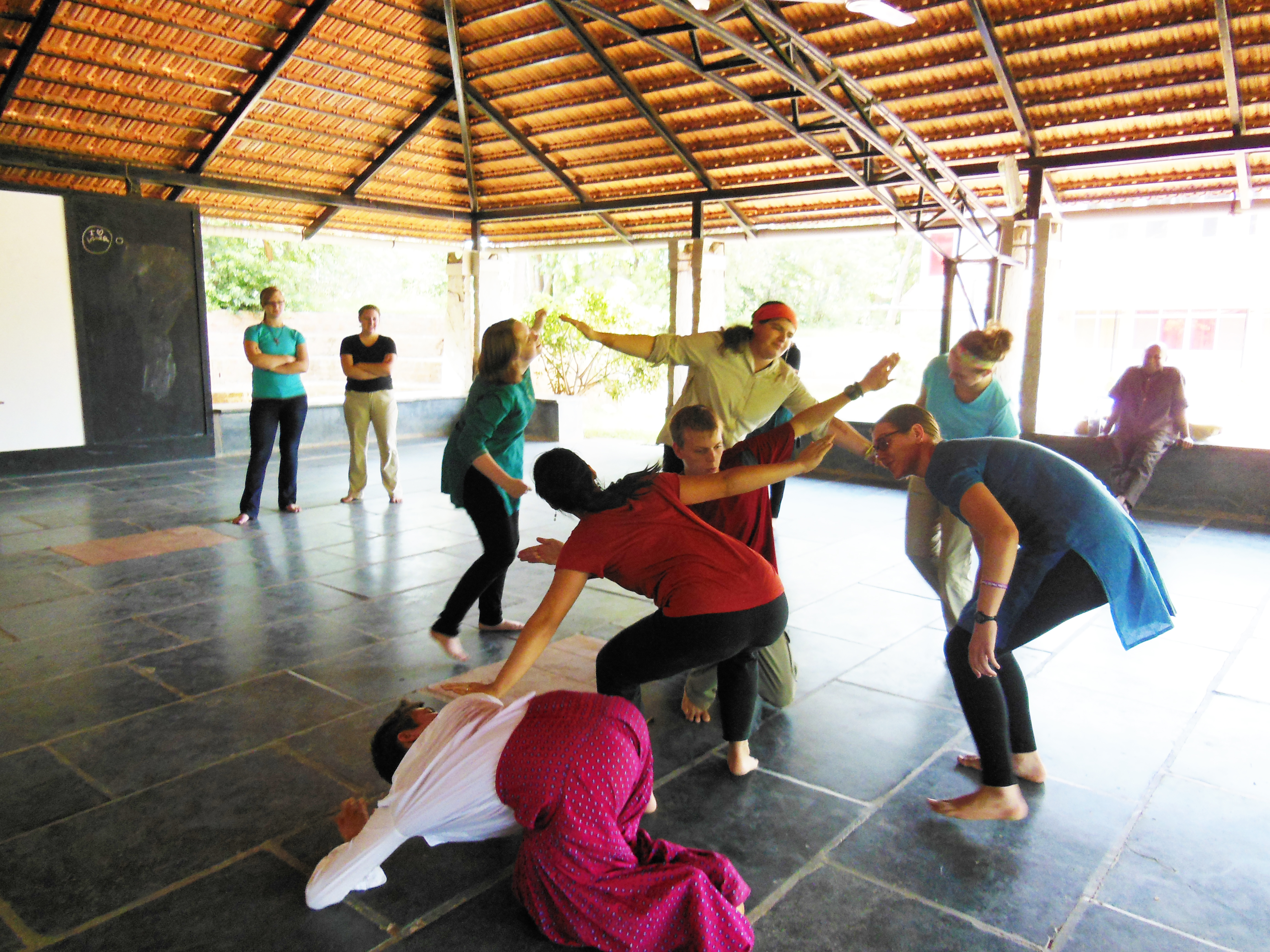
Once we had learnt everyone's names, we moved on to an exercise called 'Colombian Hypnosis' where in pairs to begin with, one person would raise their hand and the other person follow it with their bodies. The aim of this was to focus and really concentrate on the movement of the hand, reflecting it with our bodies, and getting in sync with one another. We then did it in a large group, as displayed in the picture on the left which was really interesting and we ended up creating a fluid movement. I think the exercise was useful for getting us to work as a team but it did take us a long time to get into, perhaps because we were a new group of people together. This is something that we could have improved and may improve with time. In terms of it being applicable to our work at the hospice, I think the version that we did as a group would be unsuitable due to it being quite demanding physically but it could definitely be tweaked a little so that the hand is only followed with the eyes or the head and the person stays stationary.
The exercise that I found most useful out of the lesson was individually creating still images of our thoughts and feelings before knowing anything about the project, and then again after we had been talked through the process. The beginning still images seemed to be quite negative and internal, with a lot of twisted and contorted bodies keeping themselves to themselves, perhaps reflecting apprehension and timidity. However, after the explanation people seemed to be opened up a bit more and had strengthened their stature which on the whole was a positive change. I found it quite challenging to reflect an emotion physically on the spot but there was no 'wrong' answer, which gave me the confidence to act instinctively. As I am in the theatre strand I am quite used to making things physical and I really enjoy it so am excited to try and incorporate physical theatre to the performance. This could be a good way to begin at the hospice, by asking people to maybe create a facial expression of how they are feeling if they are immobile or if they are more mobile then maybe the still image physically. Perhaps this would set people at ease, and it would be good to revisit it at the end of the session to see if people's current feelings changed over the course of the session.
The exercise that I found most useful out of the lesson was individually creating still images of our thoughts and feelings before knowing anything about the project, and then again after we had been talked through the process. The beginning still images seemed to be quite negative and internal, with a lot of twisted and contorted bodies keeping themselves to themselves, perhaps reflecting apprehension and timidity. However, after the explanation people seemed to be opened up a bit more and had strengthened their stature which on the whole was a positive change. I found it quite challenging to reflect an emotion physically on the spot but there was no 'wrong' answer, which gave me the confidence to act instinctively. As I am in the theatre strand I am quite used to making things physical and I really enjoy it so am excited to try and incorporate physical theatre to the performance. This could be a good way to begin at the hospice, by asking people to maybe create a facial expression of how they are feeling if they are immobile or if they are more mobile then maybe the still image physically. Perhaps this would set people at ease, and it would be good to revisit it at the end of the session to see if people's current feelings changed over the course of the session.
An introduction...
Our Community Arts project is working with people who visit the Saint Christopher's Hospice and creating a piece of work based on their anecdotes, stories and experiences.
Before beginning the first session, I decided to do some research into what a hospice was, having not had any personal experiences of what a hospice is like.
Google's definition of a hospice is "a home providing care for the sick or terminally ill". To me, this sounds quite clinical and seems like quite a scary prospect considering that the people there will be very ill. However, I am excited to have a new experience that I have not had before and am interested to challenge myself and be out of my comfort zone.
 |
| Dame Cicely Saunders |
When I was doing some research into hospices, I found out that St Christopher's, where we will be working, was actually the world's first modern hospice. In 1967 (which I found shocking due to how recent ago it was) Dame Cicely Saunders founded St Christopher's.
Dame Cicely was born in 1918 and started her career as a nurse and furthered it to become a medical social worker and physician. Her firm religious beliefs supported all of her work and her Christian values were what led her to creating a place where people could go specifically for palliative care, which up until the late 1960s just did not exist. According to the St Christopher's website, she was "made a Dame in 1979 and awarded the Order of Merit in 1989", showing just how crucial her work was. She passed away peacefully at St Christopher's Hospice, the place she founded just under 40 years before her death in July 2005. Her legacy is incredible, and being the first of its kind and the history behind it makes it even more special for our project.
St Christopher's Hospice is a registered charity, meaning that only 1/3 of its services are paid for by the NHS, and the rest is covered from individuals, companies and trusts, which looks after 2,500 adults per annum. It is also provides an education in palliative care in an Education Centre on the site which 4,000 health and social care professionals attend every year. Having found out all this information about St Christopher's, it has fuelled my energy to go and be a part of it, and has made me think of it as a much more 'real' place rather than an unknown, as I was regarding it as before.
On the whole, I am optimistic and positive approaching the term and will put my best effort into making the best possible piece of work for the benefit of both the patients and us, the performers.
Subscribe to:
Posts (Atom)